
Discounted Cash Flow Valuation for Irish Commercial Property
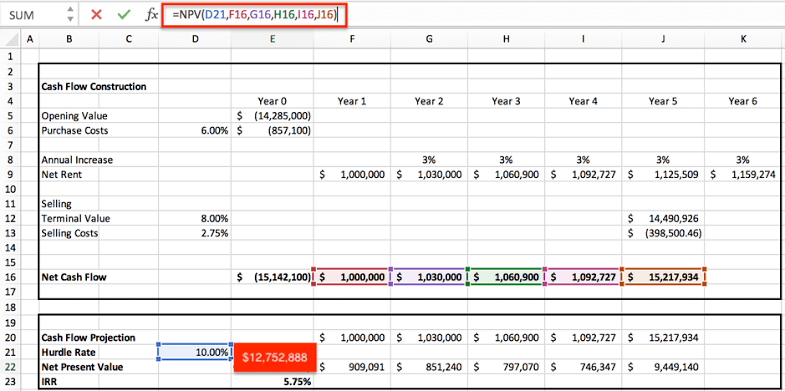
A discounted cash flow (DCF) valuation projects an asset's annual cash flows over a hold period, discounts them back to present value at a target rate of return, adds a discounted terminal value and arrives at a single present-value figure. Where the investment (capitalisation) method looks at income as a flat line, DCF captures its timing: lease events, rent reviews, capex and vacancy. For Irish commercial assets whose income isn't flat, such as reviewable leases, void periods, refurbishment plans or breaks, DCF is the institutional default. At HPS Real Estate we run DCF alongside the comparable and investment methods on all material valuations.
When to use DCF
DCF is the right tool whenever the cash flow profile isn't flat, which covers most real Irish commercial assets. In particular:
- multi-let assets with staggered lease expiries and rent reviews;
- assets with planned capex, whether refurbishment, repositioning or an ESG upgrade;
- assets with known void periods or vacancy risk;
- development sites and assets in transition;
- mixed-use schemes where yields differ by sector;
- long-leasehold and income-strip transactions.
The formula
Value = the sum, for each year t from 1 to N, of (cash flow in year t / (1 + discount rate)^t), plus terminal value at year N / (1 + discount rate)^N.
- Cash flow: NOI in each year, reflecting contracted rent, expected reviews, voids and capex.
- Discount rate: the investor's target IRR for that risk profile, typically 6 to 12 percent for Irish commercial property in 2026.
- Terminal value: the assumed sale value at year N, usually year N+1 NOI capitalised at an exit cap rate.
- N: the hold period, conventionally 5 or 10 years in Irish commercial DCFs.
Choosing the discount rate
The discount rate is the target unlevered IRR for an investor at the relevant level of risk. Our indicative 2026 ranges for Irish commercial DCFs are:
- Core Dublin offices and prime logistics: 6.5 to 8 percent.
- Core-plus secondary stock: 8 to 10 percent.
- Value-add and repositioning: 11 to 14 percent.
- Opportunistic or heavy value-add: 15 percent plus.
The rate should reflect risk, not how the deal is financed. DCFs are normally run unlevered, with leverage layered in separately for investor reporting.
Choosing the terminal cap rate
The terminal cap rate is the exit yield assumed at the end of the hold. There are three common approaches:
- Flat to entry: terminal yield equals entry yield. A neutral assumption.
- 25 to 50 bps softer than entry: allows for depreciation, wear from lease events and exit liquidity risk. This is the institutional default.
- Sharper than entry: only justified where repositioning can be demonstrated, for example moving a building from Class B to Class A through a capex programme.
Sense-checking the result
- Compare it with the investment method. If the DCF value is well above what the asset would trade for at a market cap rate, the inputs are probably too aggressive.
- Stress-test the inputs. Run downside cases on rental growth, void length, capex overruns and the terminal cap rate. The base case should sit within a credible range.
- Work backwards to the assumptions. Ask what rental growth and exit yield the DCF is actually pricing in. If a buyer wouldn't share that view of the market, the value won't stand up.
Limitations
DCF is very sensitive to its assumptions. A small move in the discount rate or terminal cap rate produces a large change in value. The skill lies in setting inputs that can be defended with market evidence, not in the arithmetic. Good practice is to disclose the key assumptions and check the DCF result against the investment method.
Frequently asked questions
When should DCF be used to value Irish commercial property?
When the cash flow profile is not flat: multi-let assets, planned capex, void periods, lease event-heavy schedules and development transitions. For simple flat-income single-let assets, the investment method alone is usually sufficient.
What discount rate is appropriate for Irish commercial DCF?
2026 indicative ranges: core 6.5 to 8 percent, core-plus 8 to 10 percent, value-add 11 to 14 percent, opportunistic 15 percent plus. The right rate reflects the risk profile, not the financing structure.
How long should the hold period be in a DCF?
Five or ten years is conventional in Irish commercial DCFs. Longer holds (15 to 25 years) are used for long-leasehold and ground-rent structures. The terminal value typically does more work than the cash flows themselves.
What is the terminal cap rate?
The yield at which the asset is assumed to be sold at the end of the hold period. The institutional convention is to soften 25 to 50 bps from the entry cap rate to reflect lease-event wear and exit liquidity risk.
Is DCF used alongside the investment method?
Yes. Best practice on Irish commercial valuations is to run DCF alongside the investment method (comparable yield times NOI) and triangulate. If the two diverge materially, the valuer must understand and explain why before settling on the reported value.
HPS Real Estate advises on the valuation of Irish commercial property for fund reporting, acquisitions, disposals, probate and lease events. Contact info@hpsproperty.ie.